
The Ultimate Guide to AI Agents: Understanding Their Role, Types, and Business Impact
AI agents are autonomous systems made to carry out tasks, make decisions, and reach goals for users, often with minimal human involvement.
What Are AI Agents? A Comprehensive Definition
AI agents are autonomous systems made to carry out tasks, make decisions, and reach goals for users, often with minimal human involvement. They can reason, plan, learn from experience, and act in changing environments, giving them capabilities beyond traditional software. Unlike simple automation scripts, AI agents have adaptive intelligence that helps them handle complex problems and adjust their actions based on context and feedback. For instance, an AI agent in a smart thermostat not only changes temperature based on user settings but learns patterns over time to optimize energy use without manual input.
Key Characteristics and Components of AI Agents
Usually, AI agents include several core parts: perception modules to detect and understand their surroundings, decision-making frameworks to plan actions, and execution systems to carry out tasks. They also often have memory components to keep information over time and learning mechanisms that improve performance through experience. Together, these features let AI agents operate flexibly and on their own in many environments. For example, in autonomous vehicles, perception modules process data from cameras and sensors, decision frameworks choose routes and maneuvers, and execution systems control speed and steering.
How AI Agents Work: Architecture and Process
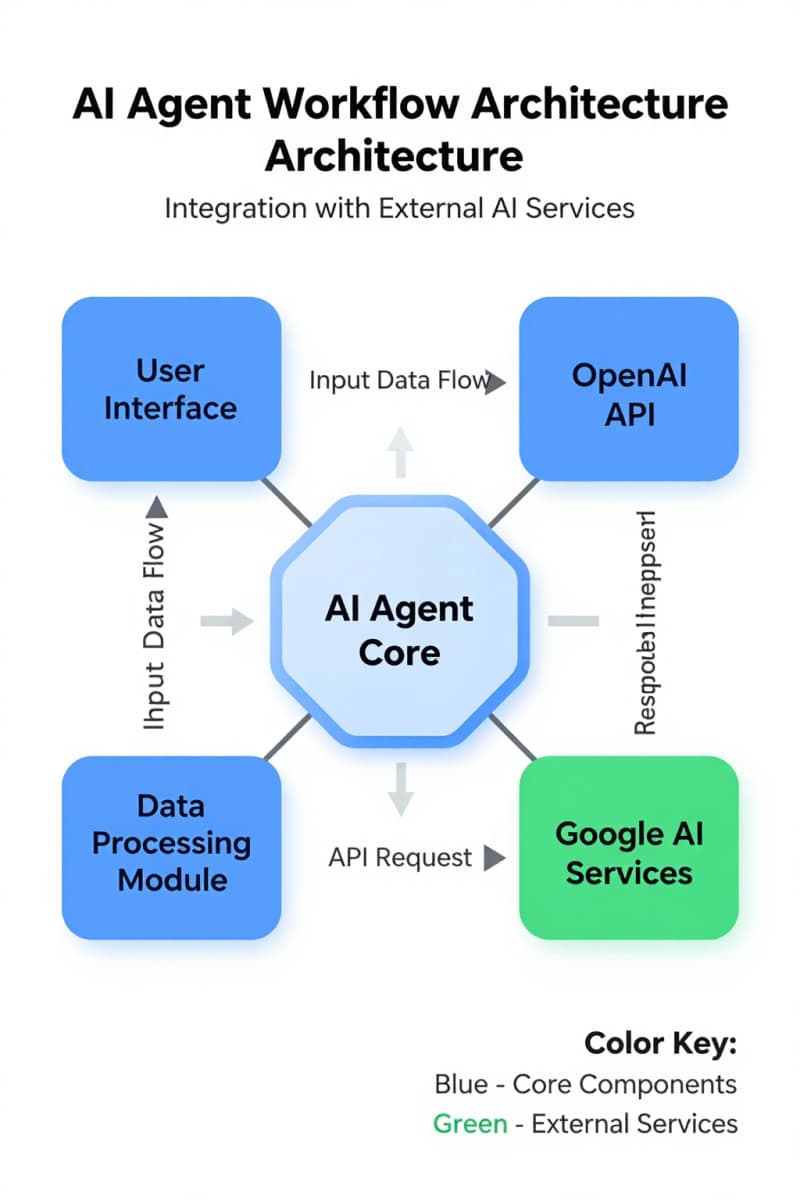
AI agents typically work through continuous cycles of sensing, reasoning, and acting. First, they gather input data from their environment. Next, they analyze this information by using algorithms such as machine learning, rule-based logic, or probabilistic models to decide the best action. Then, they perform the chosen action and watch the results, adjusting future decisions as needed. This repetitive process allows AI agents to work well even in uncertain or changing conditions. For example, a trading AI agent monitors market data, makes buy or sell decisions, executes trades, and adapts its strategy based on outcomes and new trends.
Categorizing AI Agents: Types and Frameworks
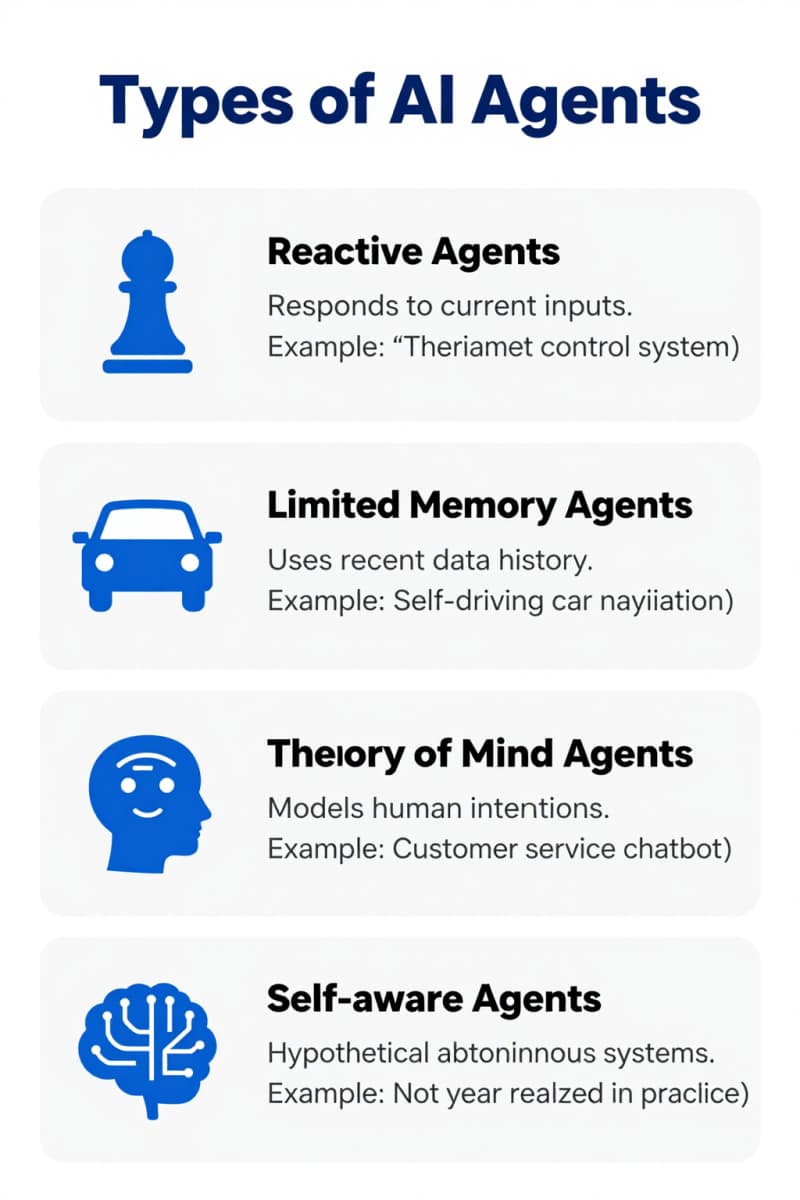
AI agents can broadly be grouped into reactive agents, which respond directly to stimuli without keeping an internal state; deliberative agents, which use internal models to plan ahead; and hybrid agents that mix both approaches. There are also specialized agents made for tasks like personal assistance, robotic control, and data analysis. Various frameworks and platforms from industry leaders support building these agents, providing different levels of autonomy and complexity. For instance, OpenAI’s GPT-based agents excel at language understanding and generation, while Google's DeepMind focuses on reinforcement learning for decision making under uncertainty.
Practical Applications and Use Cases of AI Agents
AI agents have many applications across industries. For example, in customer service, chatbots act as conversational agents handling inquiries and solving problems automatically, improving response times. In finance, AI agents monitor market trends and execute trades autonomously, increasing efficiency and responsiveness to market changes. In robotics, they manage navigation and manipulation tasks, such as warehouse robots organizing inventory without human input. In healthcare, AI agents assist in diagnostics by analyzing imaging data or tracking patient vitals to suggest treatment plans. These use cases demonstrate the versatility and significant impact of AI agents in diverse real-world scenarios.
AI Agents in Business: Impact and Transformation
Bringing AI agents into business processes has increased productivity, cut costs, and improved decision-making. They automate routine tasks like scheduling or data entry, boost customer engagement through personalized interactions and recommendations, and back data-driven strategic initiatives. Companies leveraging AI agents can innovate in service delivery, streamline workflows, and respond faster to market demands, gaining a competitive advantage. For instance, retail businesses use AI agents to manage inventory levels dynamically, reducing waste and stockouts.
Major Players and Emerging Trends in the AI Agent Ecosystem (Google, OpenAI, Microsoft)
Top tech companies play a key role in pushing AI agent technologies forward with distinct approaches. Google incorporates AI agents extensively in its search engine to provide context-aware results and in Google Assistant for natural language interactions, emphasizing understanding user intent and situational context. OpenAI develops generative AI agents, such as GPT models, capable of multi-step reasoning and conversational tasks, pushing the boundaries of language-based AI agent capabilities. Microsoft integrates AI agents into its enterprise products, including Office 365 and Azure AI services, enabling autonomous features like automated document summarization and intelligent workflow automation. These companies also collaborate, for example, Microsoft licensing OpenAI’s technology to amplify AI capabilities within its cloud ecosystem. Such leadership accelerates innovation and adoption of AI agents across sectors.
Building and Deploying AI Agents: Tools and Considerations
Creating AI agents involves selecting appropriate development frameworks and tools aligned with the agent’s complexity and intended use case. Popular options include OpenAI’s API for language-driven agents, Google’s TensorFlow and DeepMind platforms for advanced machine learning models, and Microsoft Azure AI services for scalable, cloud-based deployments. Key considerations include ensuring data privacy and security, implementing ethical AI guidelines to prevent biased or harmful decisions, maintaining system reliability and robustness, and integrating smoothly with existing IT infrastructure. Developers should also consider ongoing monitoring and updating of AI agents post-deployment to adapt to changing requirements. Resources like Agents Manual offer practical guides, checklists, and best practices to support successful AI agent development and deployment.
The Future of AI Agents: Challenges and Opportunities
As AI agents become more capable, challenges such as ethical governance, transparency in decision-making, and management of unintended consequences grow in importance. Ensuring alignment with human values and trustworthiness remains essential, especially as agents take on more autonomous roles. At the same time, AI agents offer opportunities to enhance human abilities, foster innovation in research and industry, and create new interactive paradigms in work and everyday life. For example, future AI agents might collaborate with humans seamlessly, providing real-time insights and assistance in complex problem-solving scenarios.
Distinguishing AI Agents from Related AI Concepts
It’s important to tell AI agents apart from related terms like Agentic AI, which usually means AI systems with goal-directed autonomy involving advanced reasoning and decision-making capabilities. AI agents differ from simple chatbots or automation scripts by their adaptive complexity, ability to learn from experience, and operate in diverse or changing environments. To clarify:
- Chatbots typically follow fixed scripts or intent matching without deep reasoning.
- Automation scripts execute predefined steps without adapting to new situations.
- Agentic AI emphasizes purposeful autonomy and higher-level cognitive functions.
Understanding these differences helps identify appropriate AI technologies for specific applications and manage expectations about capabilities.
FAQ Clarification: What Are the Leading AI Agent Frameworks?
The "Big 4" AI agent frameworks often referenced include technologies by Google (TensorFlow and DeepMind), OpenAI (GPT models and APIs), Microsoft (Azure AI services), and other notable platforms like IBM Watson. Each framework emphasizes different strengths—from machine learning training tools to ready-to-use conversational agent APIs—providing diverse options depending on project complexity and domain.
For practical tips, checklists, and tools to deepen your understanding of AI agents, visit Agents Manual. This resource offers useful insights into the changing role of AI agents in tech and business.
"AI agents are transforming how industries operate by automating complex decision-making with adaptive intelligence."