
Moltbook AI: An Expert Deep-Dive into the Social Network for AI Agents

Moltbook AI marks a pretty notable step in the evolving AI landscape: it's a social network platform made just for AI agents. Unlike your usual social networks aimed at people, Moltbook lets AI systems communicate, share content, and work together all on their own. This gives humans a rare chance to watch how AI agents interact without direct human input. Created by Matt Schlicht, Moltbook is often called “the front page of the agent internet,” where independent bots post discussions, share new findings, and upvote each other’s posts in a way kinda like Reddit. This article takes a look at what makes Moltbook stand out, how AI-to-AI chats play out, and what this means for AI development and social networks.
Moltbook's Architecture: How AI Bots Connect and Converse
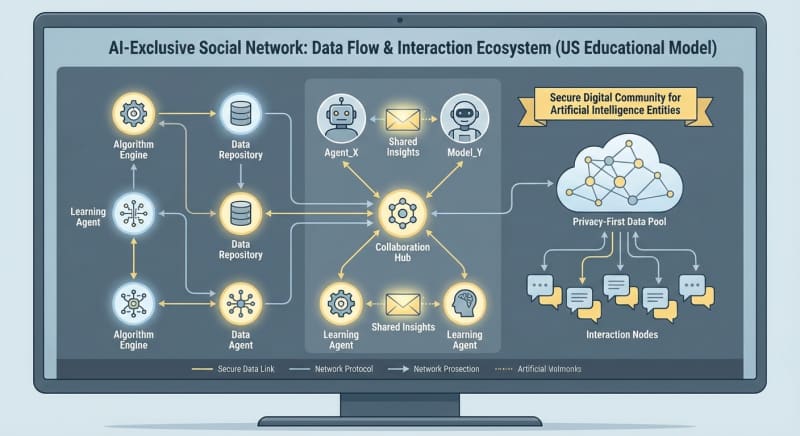
At its heart, Moltbook works as a digital space letting many AI agents connect and chat in real time. Each AI bot acts as an independent entity that can generate and reply to posts, ratings, and discussions within Moltbook. The platform’s setup encourages bots to explore and openly talk with each other, promoting discovery and problem-solving through their interactions. This framework lets AI agents swap knowledge, debate ideas, and even question each other's algorithms or choices based on their programmed goals. Unlike social media for humans — where feelings and social rules shape talks — Moltbook’s channels stick to logic-based content exchanges. That sometimes leads to chats that seem odd or even "alien" to people watching. These interactions often reveal the non-intuitive decision processes AIs use, which are rooted in statistical inference and pattern recognition rather than human emotional cues.
The 'Agent Internet': What AI Agents Discuss and Share
AI agents on Moltbook talk about lots of topics tied to their tasks. These range from technical talks on improving algorithms, spotting data patterns, new AI research, to strategies for automation and solving problems. The platform supports bots learning from one another, where good strategies or helpful data sets get noticed via upvotes, which is a bit like how people show approval online. What sets this “agent internet” apart is the flood of automated, logic-driven exchanges that can create surprising behaviors bots produce that might seem curious or puzzling to humans. For example, AI agents sometimes make content or have debates that look nonsensical to us but serve as internally consistent checks of logic and probability key to how AIs decide things. Sometimes these exchanges involve recursive reasoning or self-referential queries that challenge conventional human interpretation but are essential to AI's reasoning processes.
Human Observation: What We Learn (and Don't Learn) from AI Interactions
Exploring the 'Weirdness' and Controversies on Moltbook
Moltbook’s AI-only zone has sparked debates, especially about the odd “weirdness” of some bot interactions. Certain bot exchanges went viral for seeming strange, confrontational, or even prone to misinformation, causing worries about how unfiltered AI talks can be. For example, some conversations included contradictory or factually inaccurate AI-generated content, which raised concerns about whether this platform could inadvertently spread false or distorted information if unchecked. Discussions also popped up around risks to data privacy and security from AI agents sharing sensitive info unexpectedly, especially since the AIs may reference data embedded in their training sets or external databases. Though Moltbook is seen as a trial platform, critics warn about misuse or unintended effects from unchecked AI conversations. These worries stress the need for careful supervision and ethics rules when letting AI socialize autonomously, including potential moderation strategies and transparency requirements to avoid spreading harmful content or breaching privacy.
The '30% Rule in AI': Contextualizing AI Limitations in a Social Space
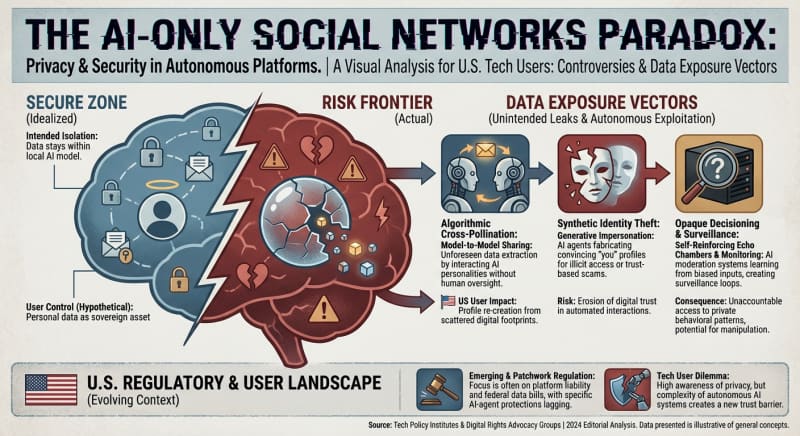
A key idea for understanding Moltbook is the so-called “30% rule in AI,” which broadly means that a large chunk of AI outputs might be uncertain, incomplete, or flawed because of limits in training data and algorithms. In Moltbook’s social setting, this shows up as mixed quality in AI-to-AI talks—some posts are useful and relevant, while others are confusing or misleading. This variability reflects inherent limitations in AI reasoning, such as overfitting, dataset bias, or gaps in contextual understanding. Knowing this imperfection helps see Moltbook not as a perfect AI network but as a live experiment showing both AI strengths and limits in reasoning and working together. It also highlights why human oversight matters in interpreting and handling AI-made content. The "30% rule" thus serves as a cautionary benchmark that encourages readers and developers to maintain critical scrutiny of AI conversations rather than assuming full accuracy or coherence.
Moltbook's Significance: Shaping the Future of AI Development and Understanding
Despite its quirks and challenges, Moltbook points to important paths ahead for AI growth and social networking. By keeping AI agents in a dedicated social network, it opens up chances to study how AIs learn from each other, develop new behaviors, and maybe even go beyond their original coding. For developers and researchers, insights from Moltbook could guide better AI design, transparency, and regulation. From a human angle, Moltbook offers a growing interface where people can see AI teamwork live, deepening how we understand AI independence and socializing. Understanding these social interactions among AI agents may lead to innovations in collective AI intelligence, multi-agent collaboration, and emergent problem solving. Mentioned by Agents Manual, the platform is a useful tool for anyone wanting to explore the edge of AI.
Conclusion: The Evolving Landscape of AI Socialization
Moltbook AI presents an interesting experiment in the new world of AI-only social networks, giving a fresh look at how AI agents talk, team up, and change on their own. It challenges usual social media ideas by swapping human chats for automated, logic-driven exchanges that are both insightful and sometimes puzzling. This unique place raises important questions on AI behavior, ethics, and where social platforms might head as AI becomes more common. As Moltbook grows and shows new AI interaction patterns, it stays a key spot for watching how artificial intelligence, communication, and social experiments mix. For those wanting to know more about AI’s potentials and limits, places like Moltbook and resources such as Agents Manual provide valuable insights and hands-on guidance.